
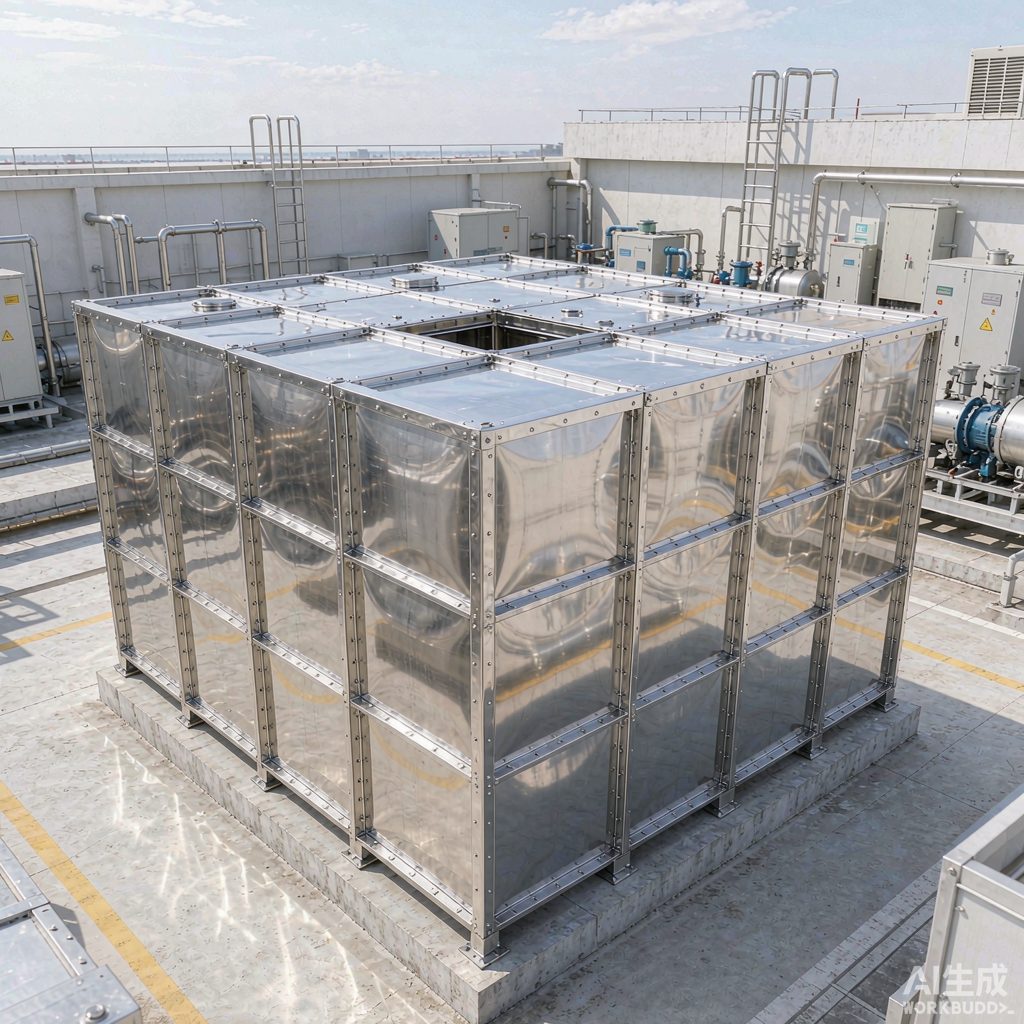
Almost every enquiry we receive ends with the same question: SMC or stainless steel? Both are modular panel tanks, both are corrosion-resistant, and both are sold as “maintenance-free”. The difference only becomes obvious once you look at the total cost over twenty years rather than the price on the quotation.
Where SMC wins
SMC (Sheet Moulding Compound) is a compression-moulded glass-fibre composite. Because the panel is moulded rather than pressed from sheet metal, we can build in reinforcing ribs, insulation and a food-grade gel-coat in a single operation. That gives three practical advantages on site:
- Thermal performance. A 12 mm SMC panel has a thermal conductivity roughly 1/300 that of 2 mm stainless steel. In hot climates this keeps stored water several degrees cooler and cuts chlorine demand.
- No condensation drip. Stainless tanks sweat in humid plant rooms unless wrapped; SMC does not.
- Lower installed cost. For a 200 m³ potable tank, SMC typically lands 25–35% below stainless once framing, insulation and freight are included.
Where stainless steel wins
Stainless is not the wrong answer — it is the right answer for two specific duties:
- High-temperature storage. Above 65 °C, standard composite resins soften their mechanical properties. SUS316L handles 90 °C comfortably.
- Sterile and pharmaceutical duty. A fully welded and passivated stainless vessel has no gasket line at all, which is what auditors and validation teams expect.
Rule of thumb from our engineering team: if the water is for people and stays below 65 °C, SMC is usually the better whole-life investment. If it is hot, or it must be weldable, choose stainless.
Comparing the numbers
Service life
A correctly installed SMC tank gives 20–30 years. A well-maintained 304 stainless tank gives 25–40 years, but 304 is vulnerable to chloride stress corrosion in coastal air; 316L is needed there, which erodes the price advantage further.
Maintenance
SMC needs an annual visual inspection and nothing else. Stainless needs periodic weld inspection at the shell courses, and any chlorinated water above 2 ppm at elevated temperature raises the risk of pitting.
What we recommend
For municipal, hospital, hotel, residential and fire-protection storage below 65 °C, specify SMC. For pharmaceutical water, food processing at temperature, or where full weldability is contractually required, specify stainless. If you are unsure, send us the water analysis and duty profile — we will tell you which one your project actually needs, even when it is the cheaper of the two.