
Qianyan Technology focuses on the manufacture and sale of water tanks including FRP water tanks and stainless steel water tanks. ✉ armand@smcwatertank.com  ·  ☎ +86 158 0665 7767

Why FRP Water Tanks

Corrosion immunity, a 20–30 year body life and food-grade water contact — the engineering case for composite storage, with the honest limits stated.

The Material

What FRP Actually Is — and Why It Lasts

FRP (fibre reinforced plastic), GRP and SMC all describe the same family of material: glass fibre reinforcement embedded in a thermoset resin. The resin provides corrosion resistance and watertightness; the fibre provides tensile strength. Neither rusts.

SMC (Sheet Moulding Compound) is the industrialised form of the material. Instead of hand lay-up, the compound is pre-mixed, matured and compression-moulded at 1,200 tonnes and 145 °C. The result is a panel with a consistent thickness, a dense gel-coat and a smooth interior finish — repeatable, batch after batch.

That repeatability is the real advantage. A bolted tank is only as watertight as its worst joint, and joints only seal if panels are flat and dimensionally accurate. Hand lay-up cannot guarantee that; compression moulding can.

A 12 mm SMC panel weighs about 19 kg/m² — roughly a quarter of the equivalent steel plate, with comparable design strength and none of the corrosion.
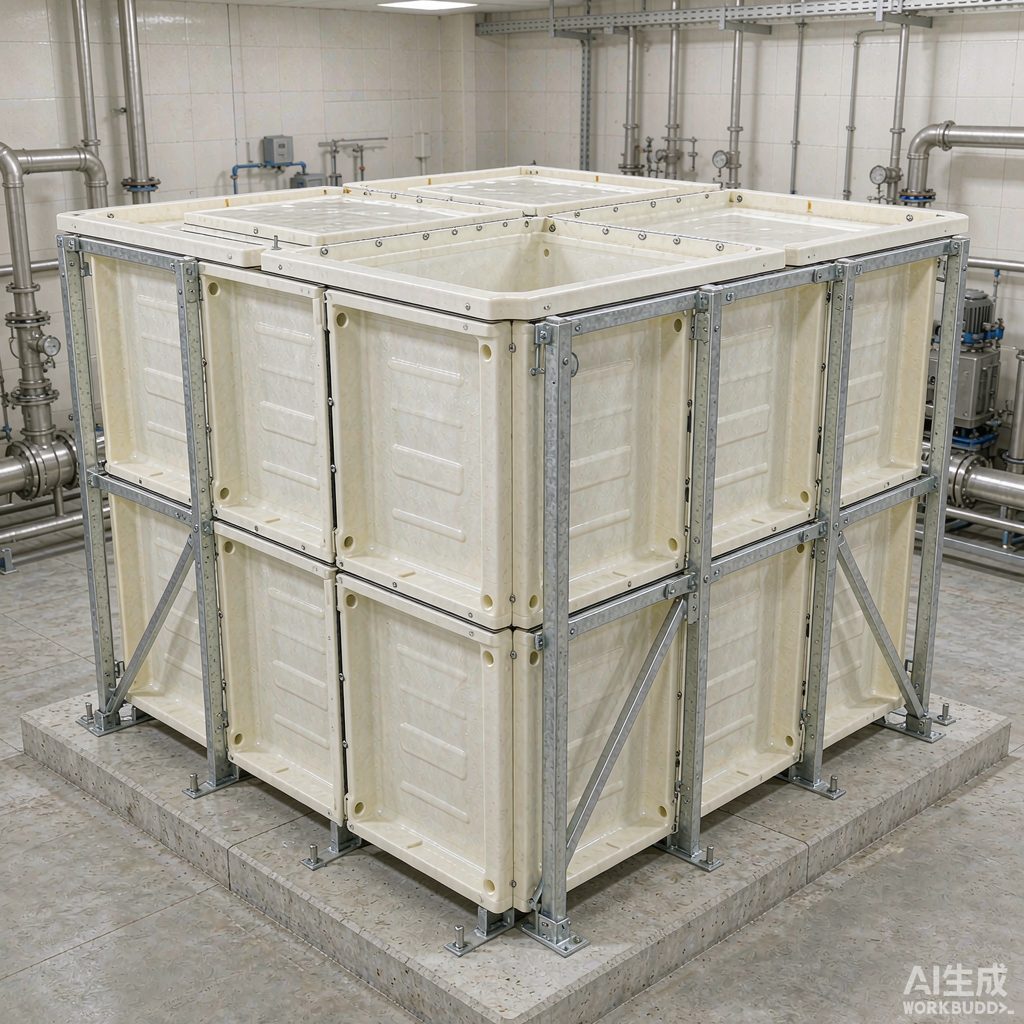
SMC sectional panel tank
Six Advantages

What You Get in Practice

20–30 Year Service Life

Our panels use a UV-stabilised isophthalic resin system with a protective gel-coat surface. Accelerated weathering tests (1,000 h QUV) show less than 5% loss of gloss and no fibre blooming, which is why we confidently rate the tank body for 20–30 years of outdoor service — roughly three times the replacement cycle of a welded steel tank.

Superior Corrosion Resistance

FRP does not oxidise, so there is no rust, no pitting and no galvanic corrosion at bolted joints. That makes it the default choice for coastal sites, desalination plants, chemical plants and fertiliser storage, where steel tanks typically need re-coating every 3–5 years.

Lightweight, High Strength

A 1 m² SMC panel weighs about 12 kg but carries the same design load as a steel plate several times heavier. Lower dead load means simpler foundations, smaller cranes, and the option to install on existing rooftops without structural reinforcement.

Modular & Fast Installation

Panels are palletised and shipped flat, so a 500 m³ tank fits into one 40 ft container. A trained crew of four assembles roughly 100 m³ per day. If demand grows, you simply unbolt one wall and add another bay — no demolition, no downtime.

Food-Grade & Hygienic

The interior gel-coat is formulated with food-contact grade resin and passes NSF/ANSI 61 and WRAS material safety testing. The mirror-smooth surface (Ra < 0.8 µm) leaves nowhere for biofilm or algae to anchor, keeping chlorine demand low and water quality stable.

Leak-Proof, Low Maintenance

Every joint uses a continuous EPDM gasket compressed by stainless bolts, backed by internal galvanised tie rods that resist hydrostatic bulging. The result is a mechanically sealed tank with no welds to crack and nothing to repaint — routine maintenance is limited to an annual visual inspection.

Comparison

FRP vs Stainless vs Galvanized vs Concrete

Nothing is best at everything. This is the honest comparison we give to clients during tender stage.

Criteria SMC / FRP Stainless Steel Galvanized Steel Concrete
Service life 20–30 years 25–40 years 10–15 years 30–50 years
Corrosion resistance ✓ Yes ✓ Yes ✗ No ✓ Yes
Weight (per m³ stored) Very light Heavy Heavy Very heavy
Thermal insulation ✓ Yes ✗ No ✗ No Moderate
Food-grade / potable ✓ Yes ✓ Yes ✗ No Moderate
On-site assembly ✓ Yes ✓ Yes ✓ Yes ✗ No
Expandable later ✓ Yes ✓ Yes ✗ No ✗ No
Installed cost Moderate High Low Low
Maintenance Very low Low Repaint often Structural checks
Lead time 25–35 days 35–50 days 20–30 days 90+ days

Indicative comparison for a 100–500 m³ potable water tank in a temperate climate. Actual figures depend on site, water chemistry and local labour cost.

Applications

Where Composite Tanks Make the Most Sense

Municipal & Potable Water

NSF/ANSI 61 and WRAS approved panels for town supply, district reservoirs and rural water schemes.

Fire Protection

Dedicated reserves with anti-vortex outlets, non-consumable storage and fire-pump connections.

Industrial Process

Cooling make-up, process water and mildly aggressive media where steel needs constant re-coating.

Hospitality & Residential

Rooftop and basement storage with low structural load, no condensation drip and silent operation.

Agriculture & Irrigation

Large-volume buffer storage that tolerates fertilizer dust, sun and temperature cycling.

Coastal & Marine

Salt-spray immunity on islands, ports and desalination plants where steel fails within years.

Need a Water Tank Quote for Your Project?

Send us your capacity, dimensions or site drawings — our engineers will reply with a layout, load calculation and price within 24 hours.